A Country on

the Clouds

We're still perfecting our mobile layout. For the best experience,


Please switch to a Desktop screen.

Continue Anyway

A Country on

the Clouds

A Country on

the Clouds

For thousands of years, the ocean didn’t just surround the islands of the Pacific; it defined the people living there.

But today, the very element that forged their identity is tearing it away, and it’s not doing on its own.

For thousands of years, the ocean didn’t just surround the islands of the Pacific; it defined the people living there. But today, the very element that forged their identity is tearing it away, and it’s not doing on its own.

October 1. Everyone left towards the airstrip all dressed up. My grandson is going to be performing today, he has been practicing his dance for quite some weeks now. Back when my son was the same age, I would always make him pulaka tulolo. Now, the best I can do is a can of corned beef.


-Losa Manuella — 54, homemaker

Hover to Learn More.

Sina, Loto, Losa, Christopher, and Penieli, all originally belong to Funafuti, the capital of Tuvalu.


A small country in the Pacific region. Along with them, Tuvalu is home to around 10,000 people.

Sina, Loto, Losa, Christopher, and Penieli, all originally belong to Funafuti, the capital of Tuvalu.


A small country in the Pacific region. Along with them, Tuvalu is home to around 10,000 people.

People are leaving.

Not just from Tuvalu, but from all over the Pacific.

A few thousand people might not affect ecosystems for major countries like the USA and India. But for these small island nations, a few thousand is their entire population.


In India, a net outflow of nearly half a million people (495,753) accounted for just 0.03% of its population.

Not just from Tuvalu, but from all over the Pacific.

A few thousand people might not affect ecosystems for major countries like the USA and India. But for these small island nations, a few thousand is their entire population.


In India, a net outflow of nearly half a million people (495,753) accounted for just 0.03% of its population.

In Tuvalu, a net loss of only 255 people wiped out nearly 2.7% of the entire nation.

For most of us, home is the place we always return to, the space that holds our memories, our ancestors, and our heart. So what pushes a person to pack up their life and turn their back on the only ground they’ve ever loved?

For most of us, home is the place we always return to, the space that holds our memories, our ancestors, and our heart. So what pushes a person to pack up their life and turn their back on the only ground they’ve ever loved?

Climate Change

Climate Change

…which is a phrase, not an explanation. It doesn't tell you why a carpenter stops rebuilding, or why a woman who fed her son pulaka feeds her grandson corned beef out of a tin.

To get there you have to follow it down. The ocean doesn't take an island all at once. It takes it in an order, and the order starts from ;

…which is a phrase, not an explanation. It doesn't tell you why a carpenter stops rebuilding, or why a woman who fed her son pulaka feeds her grandson corned beef out of a tin.

To get there you have to follow it down. The ocean doesn't take an island all at once. It takes it in an order, and the order starts from ;

The Water

The Water

Human activities - primarily burning fossil fuels and deforestation- release vast amounts of greenhouse gases, chief among them carbon dioxide (CO2).


Oceans naturally contain a lot of carbon - 38,000 gigatons of it. Ever since the Industrial Revolution, humans have contributed an additional 200 gigatons.

Human activities - primarily burning fossil fuels and deforestation- release vast amounts of greenhouse gases, chief among them carbon dioxide (CO2).


Oceans naturally contain a lot of carbon - 38,000 gigatons of it. Ever since the Industrial Revolution, humans have contributed an additional 200 gigatons.

CO₂ traps outgoing heat in the atmosphere. The ocean then absorbs that trapped atmospheric heat through direct surface contact, causing the temperatures to rise. Over decades, this has raised global average temperatures, and the ocean has absorbed ~90 % of that extra heat.

CO₂ traps outgoing heat in the atmosphere. The ocean then absorbs that trapped atmospheric heat through direct surface contact, causing the temperatures to rise. Over decades, this has raised global average temperatures, and the ocean has absorbed ~90 % of that extra heat.

The Pacific has always run hot and cold. ENSO is a natural climate pattern that controls this. It has 2 phases - El Niño and La Niña. These are cycles that control trade winds blowing the ocean water. They cause anomalies in ocean surface temperatures, maintaining an overall equilibrium. But the loop only moves heat around; it can’t remove what the atmosphere keeps adding, which is why the swings continue around a value that keeps climbing.

The Pacific has always run hot and cold. ENSO is a natural climate pattern that controls this. It has 2 phases - El Niño and La Niña. These are cycles that control trade winds blowing the ocean water. They cause anomalies in ocean surface temperatures, maintaining an overall equilibrium. But the loop only moves heat around; it can’t remove what the atmosphere keeps adding, which is why the swings continue around a value that keeps climbing.

As global temperatures rise, both on land and on water, glaciers and ice sheets melt into the ocean, adding massive amounts of fresh water. At the same time, the warming ocean water itself undergoes thermal expansion - where warmer water molecules physically expand and take up more volume- further accelerating sea level rise.

As global temperatures rise, both on land and on water, glaciers and ice sheets melt into the ocean, adding massive amounts of fresh water. At the same time, the warming ocean water itself undergoes thermal expansion - where warmer water molecules physically expand and take up more volume- further accelerating sea level rise.

When the easterly Pacific winds blow from east to west, they also push warm water ahead of them. This results in a cumulative increase in the western Pacific region.

When the easterly Pacific winds blow from east to west, they also push warm water ahead of them. This results in a cumulative increase in the western Pacific region.

King Tide (noun)

An exceptionally high, non-scientific spring tide occurring once or twice a year when the alignment of the Earth, Moon, and Sun coincides with the Moon’s closest approach to Earth (perigee), frequently causing coastal flooding.

Tides and King tides become more devastating for the low-lying islands as the baseline has shifted upwards. Funafuti’s airstrip, which is the island’s primary connection to the outside world, regularly floods from underneath, blocking off travel and emergency transport.

At Funafuti the sea has risen about 5 mm a year over the past thirty years, roughly 15 cm since 1993 - about one and a half times the global rate.

Beyond their impact on land, rising temperatures, ocean acidification, and sea level rise disrupt the marine food chain at every level, destroying corals and decimating local fish populations. It hurts the tiny islands even more, as the entire islands are built in accordance with the marine ecosystem. Especially the coral reefs.

The Reef

The Reef

Atoll (noun)


A ring-shaped coral reef or island enclosing a central lagoon, formed around a submerged volcano.

Underwater Volcano (noun)


A vent or fissure on the ocean floor that erupts magma and ash beneath the water.

Why are corals so important to the Pacific nations, in particular?

Reef imagery and benthic habitat data courtesy of the Allen Coral Atlas (Imagery © Planet).

Unlike regular islands, a lot of islands in the Pacific region are atolls. These began as living coral reefs around underwater volcanoes, millions of years ago. As the volcano sank, the coral kept building upward to stay in the light. The island is what it left behind, a ring of its own dead skeletons packed into limestone, with a thin layer of living reef on top. (e.g., Tuvalu, Kiribati, Marshall Islands). That’s why these coral atolls are usually ring-shaped.


Present-day coral reefs act as a natural barrier by diluting the impacts of tides, storms and water trying to destroy land.

The bright, colourful corals we see are marine animals made up of thousands of soft-bodied creatures like polyps. Like many things in nature, polyps can’t exist on their own. They rely on microalgae called Zooxanthellae. The polyps provide the algae with shelter and important compounds, and the algae offer oxygen and contribute to the bright pigments we see.

The bright, colourful corals we see are marine animals made up of thousands of soft-bodied creatures like polyps. Like many things in nature, polyps can’t exist on their own. They rely on microalgae called Zooxanthellae. The polyps provide the algae with shelter and important compounds, and the algae offer oxygen and contribute to the bright pigments we see.

(


Zooxanthellae

(Microalgae)

+


Coral Polyp

)


+


Calcium Carbonate

Skeleton

=


Living

Coral Colony

(

Zooxanthellae

(Microalgae)

+

Coral Polyp

)

+

Calcium Carbonate

Skeleton

=

Living Coral Colony

When water temperature rises even 1 to 2°C above the summer maximum for a sustained period, the algae start producing excess reactive oxygen species, which become toxic to the coral host. The coral responds by expelling the algae, which also removes the pigments that give coral its colour, leaving the white calcium carbonate skeleton showing through tissue that is now transparent, hence “bleaching.”

When water temperature rises even 1 to 2°C above the summer maximum for a sustained period, the algae start producing excess reactive oxygen species, which become toxic to the coral host. The coral responds by expelling the algae, which also removes the pigments that give coral its colour, leaving the white calcium carbonate skeleton showing through tissue that is now transparent, hence “bleaching.”

Bleached corals aren’t dead, but are classified as stressed.

Bleached corals aren’t dead, but are classified as stressed.

Marine heatwaves and El Niño cycles trigger widespread, simultaneous bleaching across thousands of miles of ocean.

Marine heatwaves and El Niño cycles trigger widespread, simultaneous bleaching across thousands of miles of ocean.

Dead:


Prolonged heat or starvation kills the soft living polyps entirely, while opportunistic turf algae rapidly coat the dead skeleton, preventing new polyps from anchoring and collapsing the reef ecosystem.

Alive:


Polyps and zooxanthellae live in a mutually beneficial partnership, maintaining bright colors, active growth, and full reef-building energy.

Hover to learn more

Bleaching:


Extreme thermal stress forces polyps to expel their essential microalgae, leaving the coral pale, starving, and highly vulnerable.
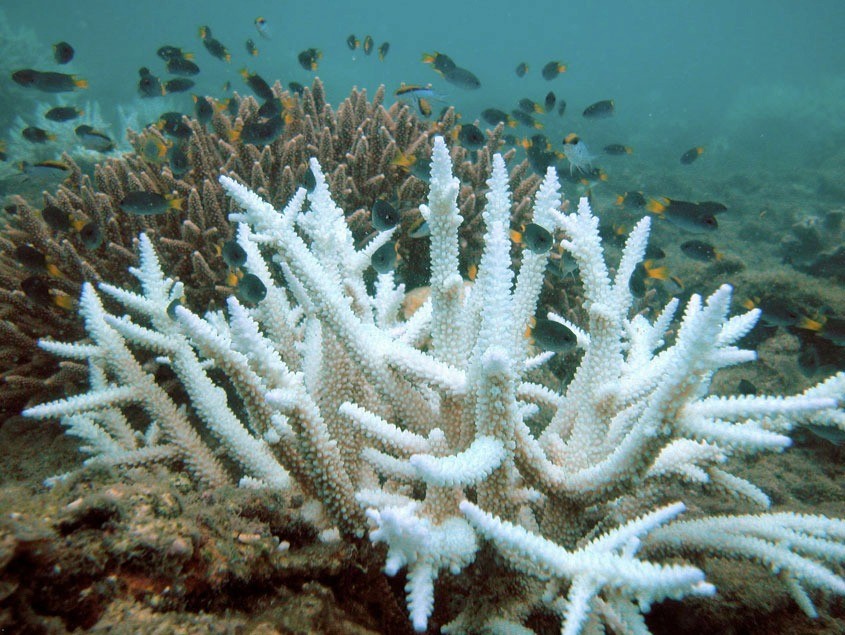

Bleached corals cannot survive on their own for long. If the water cools quickly, surviving corals take their algae back within weeks or months.

Rebuilding the reef itself nine ten to twelve years, but it seldom emerges at the same efficiency as it was originally.

Ocean acidity and wave action then erode the dead calcium carbonate skeletons.

The Land

The Land

Without the coral shield, the islands are exposed to the scary ocean waters - vulnerable to cyclones and natural disasters. This is destroying vital infrastructure, homes, and plantations. Storm surge from Cyclone Pam affected Christopher and an estimated 45% of Tuvalu's population, displacing hundreds, with Niue worst hit.

Freshwater lens (noun)


A convex layer of fresh groundwater that floats directly on top of denser seawater beneath low-lying coral islands and atolls.

Pulaka (noun)


Swamp taro (Cyrtosperma merkusii); a vital, starchy staple root crop traditionally cultivated in deep, hand-dug pits that tap into Pacific atoll groundwater.

Distance from the coastline can provide significant insight into which populations are at risk. This is particularly evident for atoll states such as Kiribati and Tuvalu, which have 100% of their population within 1 kilometre of the coast while the highest point in the entire country is 4.6 metres.

Lagoon

Fresh Water Lens

Ocean

Lime Stone

Reef

Pulaka pit

These islands are topped with a very thin layer of nutrient-poor sand, organic debris, and a freshwater lens - one of the most fragile natural systems on Earth. Since there is no surface water like rivers or lakes, this lens, along with rainwater, is the only natural source of freshwater.

The island sits on porous limestone. As the sea rises and the tides run higher, seawater pushes up through that rock from below, triggering saltwater intrusion into the pulaka pits, which are dug down precisely because that is where the fresh water is. Losa wasn’t able to make pulaka taki for her grandson because of this.

Pulaka pit photograph courtesy of Luigi Guarino (2004, CC BY 2.0)

Pulaka pit photograph courtesy of Luigi Guarino (2004, CC BY 2.0)

Tuvaluan man harvesting pulaka via OLA World

Tuvaluan man harvesting pulaka via OLA World

This isn’t just in Tuvalu. Almost all low-lying coral atolls end up having the same fate. Native staples fulfilling the nations’ nutritional requirements and sustaining generations see the fate of extinction.

This isn’t just in Tuvalu. Almost all low-lying coral atolls end up having the same fate. Native staples fulfilling the nations’ nutritional requirements and sustaining generations see the fate of extinction.

The People

The People

As saltwater intrusion destroys traditional land crops like pulaka, what about fish? Fish is not a side dish in Tuvalu. People there eat around 72 kilos a year each, more than three times the world average. Almost none of it is bought. It is caught by households, off the reef. Dead reef means lost structure, and lost structure means fewer fish.

As saltwater intrusion destroys traditional land crops like pulaka, what about fish? Fish is not a side dish in Tuvalu. People there eat around 72 kilos a year each, more than three times the world average. Almost none of it is bought. It is caught by households, off the reef. Dead reef means lost structure, and lost structure means fewer fish.

As ocean temperatures rise, tuna are migrating east. Among the ten Pacific nations that depend on them, Tuvalu faces the sharpest loss- its primary source of marine protein is simply swimming away.


Survival now comes, packaged in cans.

As ocean temperatures rise, tuna are migrating east. Among the ten Pacific nations that depend on them, Tuvalu faces the sharpest loss- its primary source of marine protein is simply swimming away.


Survival now comes, packaged in cans.

The first time there was an explosion of canned food was during the time of World war 2, when US soldiers brought millions of pounds of SPAM, tinned corned beef, and condensed milk. Because island supply lines were disrupted and local farms were altered by military bases, locals began eating canned army rations for survival.

The first time there was an explosion of canned food was during the time of World war 2, when US soldiers brought millions of pounds of SPAM, tinned corned beef, and condensed milk. Because island supply lines were disrupted and local farms were altered by military bases, locals began eating canned army rations for survival.

Nukufetau beach defense imagery courtesy of the U.S. Marine Corps (Photo: J.A. Miller, 1943)

Nukufetau beach defense imagery courtesy of the U.S. Marine Corps (Photo: J.A. Miller, 1943)

Back then, there was optimism that the war would end.

They would go back to eating their traditional dishes again. But today, they do not know when the war will end.

They would go back to eating their traditional dishes again. But today, they do not know when the war will end.

World war 2 lasted for 4 years, and this war with climate change has been going on for decades, with no end being visible in the near future.

World war 2 lasted for 4 years, and this war with climate change has been going on for decades, with no end being visible in the near future.

Due to the high content of salt and fat in canned goods, they also bring major risks of cardiovascular diseases and health issues like diabetes. Non-communicable diseases account for about 60% of deaths in Tuvalu, and obesity is above 45%. They can no longer afford to eat their own local cuisine.

Data Source 1 2

The Pacific did not cause this. It is just the first in line to experience somebody else’s consequences.

A small coral atoll with uncertain futures, climatic anomalies, wreckage of infrastructure and homes. The Tuna look toward the east. The people toward the south, but only one of them is asked for papers.

A small coral atoll with uncertain futures, climatic anomalies, wreckage of infrastructure and homes. The Tuna look toward the east. The people toward the south, but only one of them is asked for papers.

War is not always what we imagine. It isn’t always guns, bombs, people firing at each other. It could sometimes mean a cyclone wiping out your entire food supply, erasing culture and heritage.


This was then recognised when a Kiribati man, Loane Teitiota, sought asylum in New Zealand and was denied. 7 years later, He took it to the UN, which in 2020 ruled against him too - the danger, it decided, was not yet close enough. But along with this, this also happened to be the first time that the world acknowledged that a forced return to a climate-ravaged nation can violate a person’s fundamental right to life.

War is not always what we imagine. It isn’t always guns, bombs, people firing at each other. It could sometimes mean a cyclone wiping out your entire food supply, erasing culture and heritage.


This was then recognised when a Kiribati man, Loane Teitiota, sought asylum in New Zealand and was denied. 7 years later, He took it to the UN, which in 2020 ruled against him too - the danger, it decided, was not yet close enough. But along with this, this also happened to be the first time that the world acknowledged that a forced return to a climate-ravaged nation can violate a person’s fundamental right to life.

Nations like Australia have announced Immigration pathways and treaties to help the people of the Pacific and people affected by the environment.

Nations like Australia have announced Immigration pathways and treaties to help the people of the Pacific and people affected by the environment.

Falepili /fɑːleɪˈpiːli/

noun

A traditional Tuvaluan principle of good neighborliness, mutual respect, and communal duty of care.

One of them is the Falepili Union treaty signed between Tuvalu and Australia. It established the world’s first bilateral climate-mobility treaty, granting up to 280 Tuvaluans a year permanent residency in Australia, with healthcare, education and settlement support from the day they arrive. Sina has immigrated to Australia under this treaty.

The decision of who can get a climate visa is purely based on a lottery. Here is a visualisation of how many people applied and how people were fractioned at every stage, till the last 100 people successfully immigrated to their new home.

The first ballot opened on 16 June 2025 and closed a month later. 8,750 people registered - more than half the country, all hoping to see their name in the final list of 280.

The first ballot opened on 16 June 2025 and closed a month later. 8,750 people registered - more than half the country, all hoping to see their name in the final list of 280.

Leaving home and adjusting in a new place is always hard for anyone. If home is a universal feeling, so is losing a feeling a universal experience. To make it easier for people to feel at home, thousands of kilometres away, immigrant populations form communities to stay in touch with their roots. They gather and organise events to preserve their identity. Penieli is one of the community leaders who welcomes Tuvaluan people to Australia.

Leaving home and adjusting in a new place is always hard for anyone. If home is a universal feeling, so is losing a feeling a universal experience. To make it easier for people to feel at home, thousands of kilometres away, immigrant populations form communities to stay in touch with their roots. They gather and organise events to preserve their identity. Penieli is one of the community leaders who welcomes Tuvaluan people to Australia.

However, not everyone has recently left; some have left before generations, so their grandchildren have no other connection to actually discovering and experiencing their identity if it weren’t for communities like these. This is especially true for nations like Niue, where about 35,000 Niueans live in New Zealand, and fewer than 1,700 remain on the island.

However, not everyone has recently left; some have left before generations, so their grandchildren have no other connection to actually discovering and experiencing their identity if it weren’t for communities like these. This is especially true for nations like Niue, where about 35,000 Niueans live in New Zealand, and fewer than 1,700 remain on the island.

The Hope

The Hope

Everyone has not left. Even if the immigration numbers are drastic, there are people still on the island. Going about their life. Protecting whatever they have left.

Everyone has not left. Even if the immigration numbers are drastic, there are people still on the island. Going about their life. Protecting whatever they have left.

Tuvalu has often taken centre stage in global climate diplomacy. From Simon Kofe, then Minister for Justice, Communication and Foreign Affairs, giving a COP26 address standing knee-deep in seawater to Climate visas, Tuvalu has tried to force world leaders to confront the human reality of climate change at every chance possible.

Tuvalu has often taken centre stage in global climate diplomacy. From Simon Kofe, then Minister for Justice, Communication and Foreign Affairs, giving a COP26 address standing knee-deep in seawater to Climate visas, Tuvalu has tried to force world leaders to confront the human reality of climate change at every chance possible.

Along with words, the government has been doing what it can, with actions as well. To keep citizens safe on their actual land, Tuvalu launched the Tuvalu Coastal Adaptation Project (TCAP)- a landmark initiative backed by $36M+ from the Green Climate Fund.

Photo: © TCAP / UNDP via Flickr

Photo: © TCAP / UNDP via Flickr

On Funafuti (Fongafale), TCAP has dredged lagoon sand to reclaim 7.8 hectares of high-elevation land. Designed to stay safe above storm surges and sea levels beyond the year 2100, this platform acts as a long-term sanctuary. Meanwhile, mega-container barriers along outer islands like Nanumea break incoming wave energy before it reaches living areas.

On Funafuti (Fongafale), TCAP has dredged lagoon sand to reclaim 7.8 hectares of high-elevation land. Designed to stay safe above storm surges and sea levels beyond the year 2100, this platform acts as a long-term sanctuary. Meanwhile, mega-container barriers along outer islands like Nanumea break incoming wave energy before it reaches living areas.

The locals haven’t lost hope either. For years, local volunteer groups have been putting active efforts into reclamation by planting Mangroves on the coastlines, hoping to dampen the shocks of the high tides washing the island’s shores.


Loto too, is one of them.

Mangrove planting photograph courtesy of the Australian Department of Foreign Affairs and Trade (2013, CC BY 2.0), & Den and Mark / kiwi2tuvalu (2019)

Adaptation isn’t one-size-fits-all in the Pacific. While Tuvalu builds sea walls and reclaims land through TCAP, Niue relies on decentralised rainwater catchments to protect its communities when underground wells turn brackish.


Despite the aids, despite the efforts; Nature remains unpredictable. Culture passing through for thousands of years could suddenly disappear into the ocean.

Adaptation isn’t one-size-fits-all in the Pacific. While Tuvalu builds sea walls and reclaims land through TCAP, Niue relies on decentralised rainwater catchments to protect its communities when underground wells turn brackish.


Despite the aids, despite the efforts; Nature remains unpredictable. Culture passing through for thousands of years could suddenly disappear into the ocean.

When living in a reality where the worst-case scenario could be tomorrow, it becomes necessary to try all different strategies to protect your future, even if it means going a little unconventional. The Tuvaluan government launched the Future Now Project- a proposal to redefine statehood by creating the world’s first digital nation.

When living in a reality where the worst-case scenario could be tomorrow, it becomes necessary to try all different strategies to protect your future, even if it means going a little unconventional. The Tuvaluan government launched the Future Now Project- a proposal to redefine statehood by creating the world’s first digital nation.

In September 2023, Tuvalu amended its constitution, unanimously, to declare its statehood and its maritime boundaries permanent — regardless of what the sea does to the land beneath them. Pronouncing,

In September 2023, Tuvalu amended its constitution, unanimously, to declare its statehood and its maritime boundaries permanent — regardless of what the sea does to the land beneath them. Pronouncing,

"The State of Tuvalu within its historical, cultural, and legal framework shall remain in perpetuity in the future, notwithstanding the impacts of climate change or other causes resulting in loss to the physical territory of Tuvalu."

Land can drown, but memory doesn’t have to. Explore Tuvalu’s virtual counterpart below:

Land can drown, but memory doesn’t have to. Explore Tuvalu’s virtual counterpart below:

This isn’t a cry for sympathy or condolences. But a step towards wishful thinking and hope that one day we live in a world where we don’t have to experience things first-hand to empathise with someone.

This isn’t a cry for sympathy or condolences. But a step towards wishful thinking and hope that one day we live in a world where we don’t have to experience things first-hand to empathise with someone.

Designed & Developed by Srishti & Idhika

Designed & Developed by Srishti & Idhika

Create a free website with Framer, the website builder loved by startups, designers and agencies.